
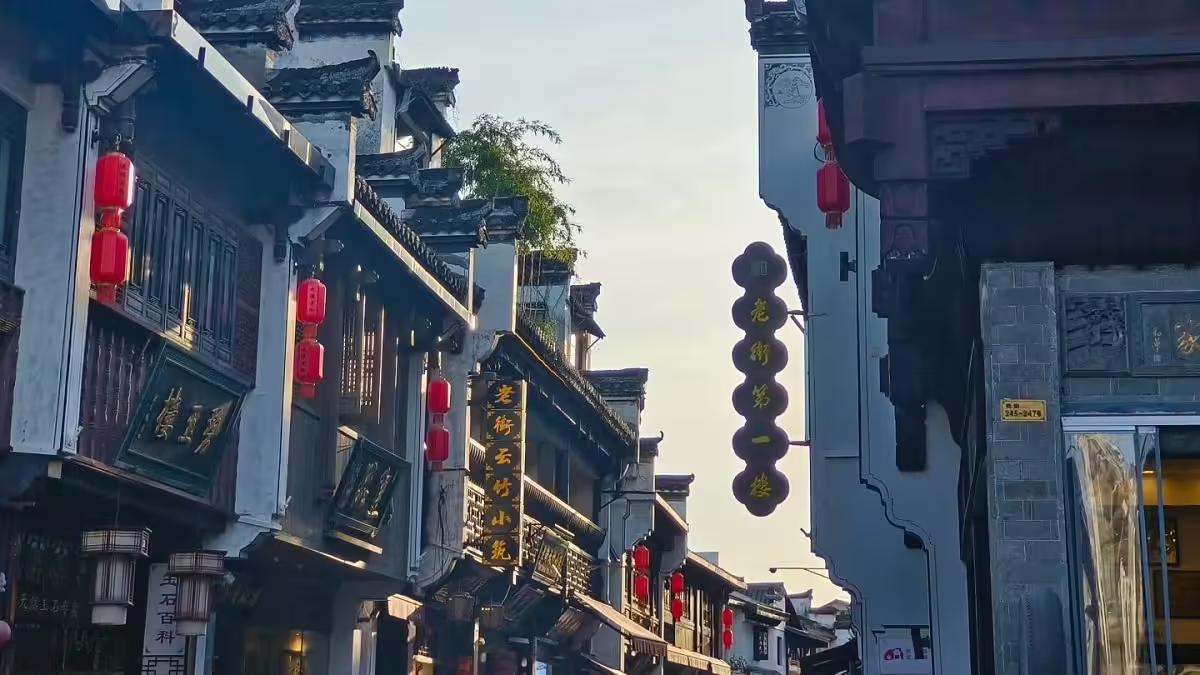
Tunxi Old Street (屯溪老街) is located in the heart of Tunxi District in Huangshan City, nestled between lush green mountains and flowing waters. With the verdant Huashan Mountain to the north and the eternally blue Xin’an River to the south, it is often celebrated as a living version of the “Qingming Shanghe Tu” (Along the River During the Qingming Festival), an iconic Chinese painting.
The street is lined with shops that showcase a uniform architectural style typical of Huizhou, featuring distinctive horse-head walls, small blue tiles, intricate wooden carvings, golden signboards, and elegant, double-eaved pavilions. The blend of ancient simplicity and refined beauty radiates a rich cultural aura, making it a remarkable artistic corridor of ethnic traditions.
Tunxi Old Street has also captured the attention of the film industry, serving as a backdrop for over a hundred films and television productions. Its enchanting atmosphere draws visitors who wish to experience a vibrant blend of history, culture, and art.
Travel Information about Tunxi Old Street
Ticket Information and Opening Hours
Ticket Price: Free admission.
Opening Hours: Open all day.
Getting to the Scenic Area
Public Transport: You can take Bus 21 from Huangshan Railway Station or the High-Speed Railway Station, and get off at the Laojie Ermalu Station to reach the Old Street.
Scenic Area Ratings
- Cultural Experience: ★★
- Unique Features: ★★★
- Leisure Activities: ★★★★
- Beauty of the Area: ★★★
- Romantic Atmosphere: ★★
- Adventure Level: ★★
Development History of Tunxi Old Street
The formation and development of Tunxi Old Street are closely linked to the relocation of the Song Dynasty’s capital to Lin’an (present-day Hangzhou) during the reign of Emperor Huizong. At that time, extensive construction took place in the Song capital, leading to the transportation and conscription of a large amount of Huizhou timber and craftsmen along the Xin’an River to Hangzhou. After completing their work, many of these craftsmen returned to their hometowns and began constructing shops that mimicked the architectural style of Songcheng (Song City). As a result, these buildings, which followed the Song dynasty style, are referred to as “the present Song City.”
With the rise of Huizhou merchants and the development of waterway transportation, Tunxi Old Street gradually evolved into a comprehensive commercial street.
During the late Yuan and early Ming dynasties, a Huizhou merchant named Cheng Weizong established 47 shops along the Old Street. Besides a few self-operated businesses, most served as inns that attracted merchants and stored goods, facilitating the exchange of materials between the mountainous region and the outside world.
By the early Qing Dynasty, the Old Street had expanded to four li (approximately 2 kilometers) in length. In the late Qing Dynasty, Tunxi tea merchants emerged, boosting the export of Tunxi green tea. Numerous tea houses and businesses opened, leading to a gradual eastward extension of the street from the original eight inns, ultimately forming the Old Street we see today. By the early Republican period, Tunxi Old Street had developed into a significant commercial hub, serving as a key point for trade between Shanghai and Hangzhou.
Highlights of Tunxi Old Street
Wancui Building
Located on Tunxi Old Street, Wancui Building is one of the few privately owned museums in China that showcases ancient architectural forms. Its gray-green tiles, white horse-head walls, red columns with lattice windows, sweeping eaves, and intricate stone, brick, and wood carvings exemplify the characteristics of traditional Huizhou architecture.
The collection at Wancui Building covers a wide range of artifacts reflecting the rich culture of ancient Huizhou. From everyday items to elaborate artworks, the exhibits depict the lives of common people, scholars, and merchants in Huizhou, recreating a vivid and authentic scene of life in ancient Huizhou. Since its opening in 1999, Wancui Building has attracted numerous prominent figures from various fields, gaining significant recognition in both the collection and cultural communities.
The second floor of Wancui Building features exhibitions of cultural relics from various dynasties and exquisite ceramic art from renowned masters. On the third floor, the front hall and rear corridor showcase the classic design of a Huizhou residence, adorned with large traditional paintings that reflect the region’s artistic heritage.
The fourth floor boasts a rooftop garden designed in the Huizhou style, complete with blue tiles, white walls, flowerbeds, and bonsai displays. Visitors can enjoy a picturesque view of the Qian’an River and the charming scenery of the ancient street from the balcony, making it a serene escape that highlights the beauty of Huizhou culture.
The Owner of Wancui Building
Wan Renhui is the owner of Wancui Building and hails from Youlan Township in Nanchang. In his youth, he studied under the renowned ceramic artist Tu Juqing, a master of the Nanchang school in Jingdezhen, where he learned poetry, inscriptions, calligraphy, painting, and pottery. He furthered his studies with ceramic archaeologist Professor Liu Xinyuan and Guangdong archaeologist Zhao Ziqiang, as well as Xie Zhifeng, the president of the Guangdong Cultural Relics Appreciation Association.
From an early age, Wan Renhui developed a deep fascination with traditional culture and the allure of Huizhou architecture. After venturing into business in the 1990s and achieving success, he dedicated significant time and resources to collecting artifacts. He traveled extensively throughout the Huangshan region to acquire old components of Huizhou architecture. Wan Renhui has made substantial contributions to the inheritance, protection, and promotion of Huizhou culture, ensuring that its rich heritage continues to thrive.
Tunxi Museum
Located diagonally across from Wancui Building, Tunxi Museum is another notable attraction on Old Street. Covering an area of approximately 700 square meters, the museum features two main exhibition halls that showcase a rich collection of Ming and Qing dynasty furniture, ancient calligraphy and paintings, ceramics, jade artifacts, bronze vessels, writing implements, and Huizhou brick carvings.
Among its treasured exhibits are a Qing dynasty brick carving of a character door cover, a She stone ink slab, a glazed ceramic pillow from the Fahua period, and Spring and Autumn bronze artifacts. The second floor is dedicated to ancient calligraphy and ceramics, including a rare piece from the Qianlong period depicting the “Four Auspicious Symbols” (福禄寿喜图).
The museum hosts three major thematic exhibitions: the “Huizhou Brick Carving Art Exhibition,” the “Huizhou Portraits Exhibition,” and the “Ming and Qing Furniture Exhibition.” These exhibitions primarily showcase Huizhou’s brick carving artistry, painting traditions, and ancient furniture craftsmanship, reflecting the region’s culture and social norms.
Dai Zhen Park
Dai Zhen Park is centrally located in Tunxi District, at the intersection of Yan’an Road and Zhimalu, close to Tunxi Old Street. Established in 1982, the park was initially named Huashan Park due to its position on Huashan Mountain, but was later renamed in honor of the esteemed philosopher Dai Zhen.
Originally, the area housed Huashan Temple, which has since been destroyed. Spanning approximately 300,000 square meters, Dai Zhen Park features numerous attractions, including a statue of Dai Zhen, the Dai Zhen Memorial Hall, a boat dock at Zhu Tang, an exhibition hall dedicated to Dai Zhen, and several pavilions such as Xizhao Pavilion and Moxiang Pavilion. Visitors can also enjoy the stone arch bridge, a botanical garden, a Huizhou bonsai garden (Cuijing Garden), and a small zoo.
Who is Dai Zhen
Over two hundred years ago, the area between Huashan Ridge and Yangmei Mountain in Tunxi, known as Zhu Tang, faced devastating floods during the plum rain season. These floods not only destroyed rice fields but also inundated the town of Tunxi, causing immense suffering for the local people. At that time, a young Dai Zhen volunteered to investigate the flood-affected areas and proposed a flood prevention plan.
Together with local scholars and officials, Dai Zhen raised funds to construct a stone dam in Zhu Tang. The dam stood 10 meters high, measuring 43 meters in length and 22 meters in width, with a storage capacity of approximately one million cubic meters. A sluice gate was built at the entrance, while a drainage ditch was created to channel water directly into the Xin’an River.
Under normal conditions, the sluice gate remained closed to facilitate the breeding of fish and ducks and to irrigate the fields. However, during severe floods, the gate could be opened to release excess water, preventing further inundation of the fields and ensuring that Tunxi remained dry. This successful initiative established Dai Zhen’s reputation as a prominent figure in the community.
Tunxi Old Grand Bridge
The Tunxi Old Grand Bridge, officially named Zhenhai Bridge, was built in the 15th year of the Jiajing period of the Ming Dynasty (1536). It is a large stone arch bridge with six piers and seven arches, making it one of the few remaining large stone arch bridges from the Ming Dynasty in Anhui Province. This bridge has become a symbol of ancient Huizhou.
As a popular pedestrian bridge, the Old Grand Bridge holds cherished memories for generations of Huizhou residents. Unfortunately, on July 7, 2020, the bridge was severely damaged by flooding. In response, local authorities initiated a restoration project, employing traditional craftsmanship and techniques to ensure the bridge was restored to its original state. The Zhenhai Bridge has now been revitalized, once again spanning the confluence of the three rivers.
Laojie First Building
When it comes to dining in Tunxi Old Street, “Laojie First Building” (老街第一楼) is a renowned establishment that perfectly embodies the ancient charm of Huizhou culture. The restaurant showcases various elements of Huizhou architecture, creating an ambiance that reflects traditional aesthetics throughout its spacious halls and private dining rooms, each with a distinct theme.
The “Zhiwei Restaurant” (知味斋) features exquisite blue-and-white porcelain, while “Jiu Shi Shuang Long Quan” (九狮双龙泉) symbolizes the idea of “four waters returning to the hall.” “Kua Huojju” (快活居), on the other hand, is themed around chopsticks, with a stunning large redwood and gold leaf chopstick sculpture hanging from the ceiling, captivating every guest. Each private room is infused with unique cultural meanings, such as “Fortune, Prosperity, Longevity, and Happiness” (福禄寿喜), “Brush, Ink, Paper, and Inkstone” (笔墨纸砚), and “Qin, Chess, Calligraphy, and Painting” (琴棋书画).
Visitors can indulge in authentic Huizhou cuisine here, including dishes like “Huizhou Fermented Tofu” (徽州毛豆腐), “Yulu Chicken” (一楼如意鸡), “Huizhou Bamboo Shoots” (徽州问政笋), “Hu Family Specialty Hot Pot” (胡氏一品锅), and “Braised Stinky Mandarinfish” (红烧臭鳜鱼). The menu is diverse, featuring a variety of cooking methods and flavors, ranging from steaming and frying to braising and spicy-sweet combinations, ensuring a delightful culinary experience.
Cheng Family Three Houses
Located on Baishu Street in the Tunxi District, the Cheng Family Three Houses comprise three ancient Ming Dynasty buildings situated at No. 6, 7, and 28 East Baishu Lane. These residences were built during the Chenghua period by Cheng Minzheng, a right minister of the Ministry of Rites. Due to the fact that all three houses are Ming Dynasty structures and the homeowners share the surname Cheng, they are commonly referred to as “Cheng Family Three Houses.”
The Cheng Family Three Houses are notable for their significant research and aesthetic value. They have been praised by Professor Fu Xinian, an expert in ancient architecture from the Palace Museum in Beijing, as “a treasure of Ming Dynasty residences.” These buildings offer a glimpse into the architectural style and cultural heritage of the Ming era, making them a valuable site for both scholars and visitors interested in traditional Chinese architecture.
Architectural Features of the Cheng Family Three Houses:
The Cheng Family Three Houses consist of three buildings: No. 7 and No. 8 are connected, while No. 28 is situated to the east. Although the structures are similar, each possesses its unique characteristics.
- Building No. 7: This building was constructed in the early Ming Dynasty (1368), making it over 600 years old. It served as the family residence of Cheng Minzheng, the right minister of the Ministry of Rites and the chief examiner for Tang Bohu.
- Building No. 8: This structure is rich in cultural significance, featuring a warning stone inscribed with “滴水石穿” (Dripping Water Penetrates Stone). It also boasts a large wooden carving mural made up of 108 scenes, showcasing the essence of Huizhou woodcarving art.
- Building No. 28: This building was the residence of both officials and merchants. Its unique entrance cover is a representative example of Huizhou stone carving.
All three houses are enclosed, two-story structures with five bays, constructed using a brick-and-wood frame, and feature side rooms with a central courtyard, resembling a traditional “siheyuan” (courtyard house). Their layouts are meticulous, with exquisite decorations that exude a rustic elegance. Among these, the residence of Cheng Mengzhou is particularly notable for its beautiful architecture, characterized by a staggered height.
The residence has five bays and measures 16.1 meters deep and 13.6 meters wide. It includes side rooms flanking a central courtyard, forming an irregular “凹” shape in plan. Each beam in the structure is adorned with patterned paintings in the Ming style, which are rare in Huizhou residences of that period.
The upper hall of this residence is celebrated as “徽州第一厅” (The First Hall of Huizhou). It features a plaque inscribed with “齐眉” (Equal Brow) – a testament to the love shared by the owner Cheng Na’an and his wife, who were born on the same day. Their deep affection earned them admiration, leading Prince Yu to inscribe a congratulatory plaque for their dual birthday celebration.
Visitor Guide for Tunxi Old Street
Accommodation Options in Tunxi
Tunxi offers a wide range of accommodations, from high-end hotels to budget inns, making it easy for travelers to find a suitable place to stay. The area boasts numerous star-rated hotels with affordable prices, especially during the off-season when discounts are often available. Notable options include Huangshan Xinyuan Business Hotel (黄山馨园商务酒店), which provides a comfortable atmosphere for business travelers, and Night Boat Old Street Inn (夜泊老街客栈), popular for its cozy vibe.
Another favorite among young travelers is the Old Street International Youth Hostel (老街国际青年旅舍), located right on Old Street.
The Old Street Inn (老街口客栈), situated at the entrance of Old Street, is the only hotel in Huangshan that showcases traditional Huizhou architectural features. It was here that the famous poet Yu Dafu (郁达夫) stayed in 1934, leaving behind the renowned work “Record of Overnight Stay in Tunxi” (《屯溪夜泊记》). In the 1990s, this inn became the designated reception venue for notable film stars such as Liu Xuehua (刘雪华) and Zhong Zhentao (钟镇涛).
Another charming option on Old Street is Huizhou Residence (徽舍), a boutique hotel that attracts countless domestic and international tourists. This hotel consists of two ancient residences, “Bomingju” (泊明居) and “Jingyuantang” (静远堂), showcasing unique Qing Dynasty Huizhou architecture. Its elegant and refined style features distinct wall lines, black tiles, and white walls, exuding a rustic charm. The intricate brick, wood, and stone carvings further contribute to its distinctive local architectural character.
Shopping in Tunxi Old Street
Shopping on Tunxi Old Street offers a diverse array of options. Renowned globally, “Qihong” (祁红) tea and “Tunlu” (屯绿) tea are primarily distributed in Tunxi. The street is also filled with a rich selection of “Huimo” (徽墨) ink and “Sheyan” (歙砚) inkstones, making it a paradise for enthusiasts. Notable spots for purchasing ink and inkstones include the Hu Kaiwen Ink Factory (胡开文墨厂) next to Dai Zhen Park (戴震公园) and the Sanbai Yan Zhai (三百砚斋) located on the old street.
Additionally, the “Four Carvings of Huizhou” (徽州四雕) – which include brick, wood, stone, and bamboo—are widely available, alongside traditional Huizhou paintings, prints, stone rubbings, calligraphy, bonsai, and root carvings, all showcasing the area’s rich cultural heritage.
Food Options in Tunxi Old Street
1. Xiu Sao’s Tat Kui (秀嫂挞粿)
- Cost: ¥20 per person
- Recommendation Rating: ★★★★
Xiu Sao’s Tat Kui (秀嫂挞粿) is a must-try on Tunxi Old Street (屯溪老街). Known for its crispy yet tender texture, this local treat resembles a thin pancake but with a unique filling that packs a punch. Every bite delivers a balance of flavorful filling and crunchy crust, making it a favorite snack for many. Don’t miss this flavorful snack while you explore the street!
2. No Lemon, No Tea (不卷柠)
- Cost: ¥18 per person
- Recommendation Rating: ★★★★★
If you’re eager to taste Huangshan’s famous Mao Feng tea (黄山毛峰) but want something with a modern twist, “No Lemon, No Tea” (不卷柠) is the perfect choice. This tea shop offers a refreshing blend of lemon and premium Huangshan tea, creating a delightful drink that’s both satisfying and thirst-quenching. The shop’s chic décor and unique cups, reflecting the local Hui culture (徽州), also make it an Instagram-worthy stop for visitors.
3. Tunxi Hu Ji Shao Bing (屯溪胡记烧饼)
- Cost: ¥12 per person
- Recommendation Rating: ★★★★★
Famed for its charcoal-grilled technique, Tunxi Hu Ji Shao Bing (屯溪胡记烧饼) serves up some of the best traditional Huangshan-style shaobing. The pastries are perfectly crisp on the outside, with a delicious, savory filling on the inside. The warm, friendly service at the shop makes it an inviting place for both locals and tourists to enjoy this traditional snack.
4. Wang Yi Tiao Wonton (汪一挑馄饨)
- Cost: ¥25 per person
- Recommendation Rating: ★★★★
Located at the entrance of Tunxi Old Street (屯溪老街), Wang Yi Tiao Wonton (汪一挑馄饨) is a beloved spot for both locals and tourists. Known for its delicate, thin skin and generous, flavorful filling, the wontons here are served in a rich, savory broth that leaves a lasting impression. The comforting flavors and affordable prices make it a great option for those seeking an authentic, satisfying meal.
5. Stinky Mandarin Fish at Local Flavor Restaurant (臭鳜鱼土菜馆)
- Cost: ¥75 per person
- Recommendation Rating: ★★★★
For an authentic taste of Anhui, Earthly Flavor Restaurant (臭鳜鱼土菜馆) specializes in the famous Stinky Mandarin Fish (臭鳜鱼), a signature dish of the region. The fish is tender and juicy, cooked with a special sauce that gives it a unique, aromatic flavor that’s a bit of an acquired taste. Besides this standout dish, the restaurant also serves excellent chicken soup with stone ear mushrooms and tasty beef from Jixi (绩溪). It’s an affordable place to sample the flavors of Anhui cuisine.