
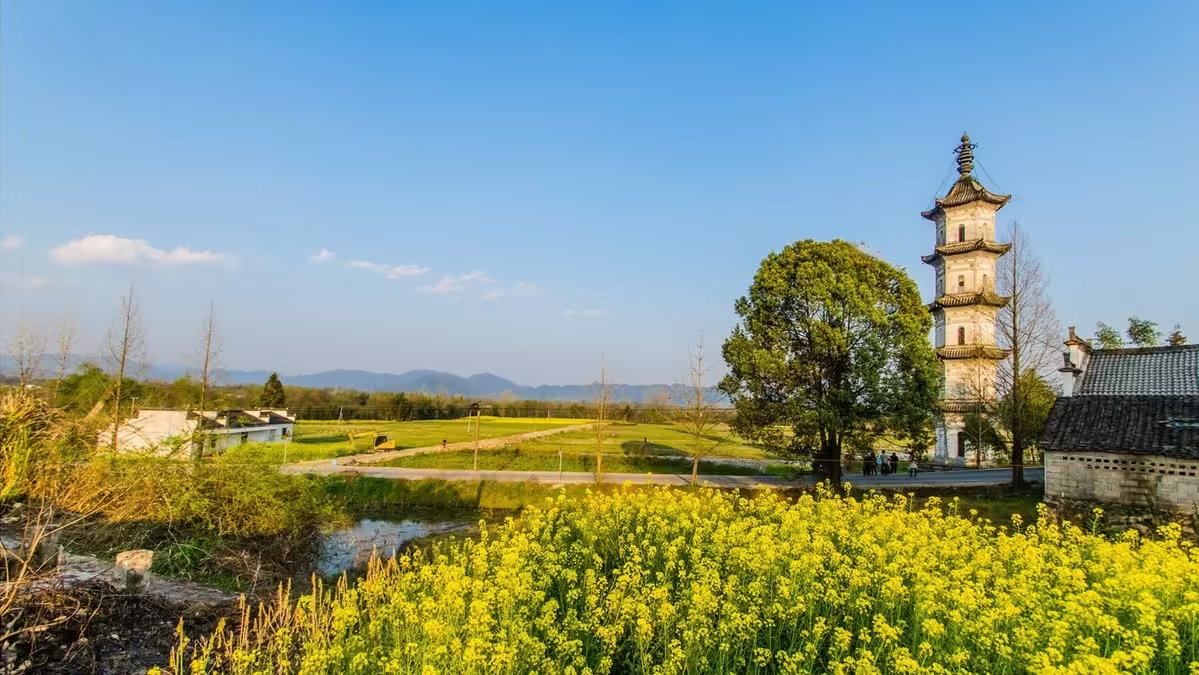
Bishan Village (碧山村) is a renowned ancient Huizhou village primarily inhabited by the Wang family, located in the historical region of Huizhou (now Huangshan City) in Yixian County. Originally named “Huangpi,” the village is also known as Sandu and was one of the twelve administrative divisions of Yixian during the Ming Dynasty.
Bishan is characterized by its picturesque landscape, with “high mountains and vast fields, paths like embroidery, and white walls with black tiles, neatly arranged.” Within the village, you’ll find the remnants of the Song Dynasty private garden, Peiyun Garden, the Ming Dynasty private school Gengdu Garden, and the ancient Qing Dynasty Yunmen Pagoda. The village has preserved over a hundred ancient residences and ancestral halls from the Ming and Qing dynasties.
According to the historical records of Xin’an Zhi, in the 12th year of the Kaihuang era (592 AD) during the Sui Dynasty, the area south of Yishan (the ancient name for Huangshan) was established as She Prefecture, with the local government set up there. Bishan Village has also been frequented by literary figures throughout history. The famous Tang Dynasty poet Li Bai once visited and composed the lines, “Ask me why I dwell in Bishan, I smile and do not reply, my heart is at ease.” This poetic connection highlights the village’s cultural significance and serene atmosphere.
Travel Information about Bishan Village
Ticket and Opening Hours
Admission: Free.
Opening Hours: Open all day.
Best Time to Visit
From March to April is the blooming season for rapeseed flowers in southern Anhui. During this time, the picturesque Bishan Village, with its white walls and black tiles, harmonizes beautifully with the distant green mountains, clear waters, and fields of yellow rapeseed flowers, creating a stunning ink-wash painting effect. Early November is also a great time to visit as the scenic Bishan hosts the Yixian Photography Exhibition.
Transportation to the Scenic Area
Location: Bishan Village is situated in Biyang Town, Yixian County, approximately 4 kilometers northwest of Yixian County Town.
Transportation: After arriving in Huangshan City, visitors can take a bus to Yixian Bus Station. From the bus station, there are direct buses to Bishan Village.
Attraction Ratings
- Cultural: ★★★★
- Special Features: ★★★★
- Recreation: ★★★
- Beauty: ★★★★★
- Romance: ★★★
- Adventure: ★★
Highlights of Bishan Village
Peiyun Garden
Peiyun Garden is a private garden established by Wang Bo, a high-ranking official during the Southern Song Dynasty who served as the Director of the Secretariat and Assistant to the Chancellor. Wang Bo, who held office at the same time as the infamous Qin Hui, resigned in protest against Qin’s corrupt practices and returned to his hometown to create Peiyun Garden.
Once, Peiyun Garden was renowned for its elegant pavilions, lush pine and bamboo groves, clear ponds, and beautiful stone formations, making it one of the great attractions of ancient Yixian. Today, visitors can see a rockery and a fragment of a stone tablet. The rockery is constructed from Taihu stones, and beneath it lies a cave-like stone chamber that can accommodate over ten people.
After Wang Bo retired, his friend Zhang Jiu Cheng traveled from afar to visit him and composed a seven-character quatrain titled “Visiting Friends at Bishan,” which he dedicated to Wang. The stone tablet inscribed with this poem still exists in Peiyun Garden today, and despite nearly 900 years of weathering, the characters remain faintly visible.
Gengdu Garden
Gengdu Garden was once a private school in Bishan Village, and its original layout has been preserved. The garden features a clear pond where fish swim playfully and frogs leap while cicadas sing. The pond’s edge still holds a traditional “beauty resting” bench, adding a touch of charm to the otherwise serious study of ancient texts.
The name “Gengdu Garden” reflects the owner’s values of simplicity and a disinterest in fame and fortune. The ancient architecture is characterized by its fresh and elegant style, with traces of the scholarly heritage visible among the vines climbing the walls. The garden consists of the main building and a study hall, including upper and lower study areas. One side of the study hall features a cultivated field, which is where the garden gets its name.
In the garden, there are osmanthus trees and longevity pine trees that are over a hundred years old. When they bloom, their fragrant flowers fill the air, creating a serene and refreshing atmosphere.
Yunmen Tower
Yunmen Tower, the landmark at the entrance of Bishan Village, was built in the 47th year of the Qianlong reign (1782) and is commonly known as the “Three Dufu Pagoda” or Wenfeng Tower, named after the nearby “Yunmen Study.”
The tower consists of five tiers and stands 36.4 meters tall. It features a cylindrical, pavilion-style brick structure with wooden eaves. The hexagonal tower body is constructed with brick and adorned with dougong brackets, while the eaves are decorated with brick carvings. Iron horses hang at the corners, producing a melodious sound when the breeze blows.
The tower’s spire is crowned with a precious orb, surrounded by national light, a treasure cover, a celestial wheel, a dew plate, and other impressive elements, creating a grand and striking appearance. The inner walls of the tower are painted in elegant and unique designs. Inside, the hollow tower features a winding staircase that allows visitors to ascend to the top.
From the highest level of Yunmen Tower, one can enjoy a panoramic view of the ancient city of Yixian, with the Zhang River flowing gracefully and the village houses lined up in harmony. Yunmen Tower is now a key cultural relic protection unit in Yixian County.
Yunmen Study
Yunmen Study, located next to Yunmen Tower, is also known as Bishan Study or Yunmen Academy. It was built during the late Qing Dynasty and early Republic of China and served as a gathering place for scholars of the Wang family.
Above the eight-character entrance gate, the words “Bishan Study” are beautifully carved in green from Yixian. The main building consists of three rooms and features small courtyards in the front and on the side. The windows and doors of the building are intricately carved, showcasing a variety of patterns, and the figures depicted are lifelike and vivid.
Shisanmen Hall
Shisanmen Hall is the ancestral hall of the Wang family located in the eastern part of Bishan Village. The hall was originally built during the Qing Dynasty and faces southeast, featuring a layout of five bays with two entrances and two corridors. While the original entrance structure had collapsed, it has been restored to its former design. At the entrance, two large Yixian stone pillars stand proudly, adorned with intricate brackets, and the beams are well-preserved.
The entire hall is constructed with substantial materials, featuring a balanced framework and a spacious middle entrance. The imposing columns and beams contribute to its grandeur, while the stone pavement in the courtyard is made of Yixian bluestone. The surrounding brackets are layered, creating a heavy and spectacular atmosphere, with the rear hall exuding solemnity and power.
This hall once served as a grain storage facility for the commune, and locals still refer to it as the “grain storehouse.” Today, the couplets depicting “Fishing, Woodcutting, Farming, and Study” on either side have faded, while the slogan painted on the wall – “Serving Farmers with Dedication” – remains partially discernible.
“Chudifang” Folk Dance
The “Chudifang” folk dance is an ancient ritual dance from Yi County, performed during traditional festivities such as the “Bishan Harvest Festival.” The term “Chudifang” refers to “Chudifang,” which symbolizes “impermanence” in local folklore and is regarded as the messenger of justice, revered by the people.
During the performance, villagers dance with bare upper bodies, wearing hats and skirts made of woven straw. As they dance, they chant loudly, offering prayers to their ancestral spirits, seeking blessings for a bountiful harvest. They express their hopes for the coming year, wishing for abundant grains and the prosperity of both livestock and crops.
Statue of Wang Dazhi
The statue of Wang Dazhi is dedicated to the renowned educator who was born in Bishan Village and was a student of Tao Xingzhi. Erected in the autumn of 2012, the statue is located near the village entrance, close to the ancestral hall.
The statue stands on a commemorative stone, with Wang Dazhi’s name, dates of birth and death, and a famous quote from Tao Xingzhi inscribed on the front: “Come with a heart and leave without a blade of grass.” The back of the stone features an inscription written by admirers, detailing Wang Dazhi’s contributions to popular education and rural development throughout his life.
Pig’s Inn
Pig’s Inn, despite its name, is a rural guesthouse that combines dining, drinking, accommodation, and entertainment. There are two locations in Bishan Village known as “Pig’s Inn II” and “Pig’s Inn III.” The inn is run by a young poet couple, and the original “Pig’s Inn I,” located in the ancient village of Xidi, was initially intended as a gathering place for themselves and their friends. However, as the inn gained popularity, more and more artists and enthusiasts were drawn to it, prompting the couple to open it to the public.
The owners treat Huizhou culture with great respect and have designed the space according to their aesthetic sensibilities. The courtyard features a large stone oil press and a workshop, which serve as nostalgic symbols of the area’s history and reflect the owners’ commitment to preserving the original architectural style.
Pig’s Inn has been featured in extensive coverage by major media outlets, including The New York Times, BBC, and the Discovery Channel. Visitors from all over the world come to experience it, including French actress Juliette Binoche and Japanese composer Joe Hisaishi, as well as diplomats from various countries hosting events. According to the owner, Han Yu, they have welcomed guests from nearly every country, except Iceland. Remarkably, the inn’s operations are managed by her husband, Zheng Xiaoguang, who speaks only about 50 words in English.
Bishan Bookstore
Bishan Bookstore is a charming establishment located in the former Qitai Hall of Bishan Village, operated by Nanjing Vanguard Bookstore. The bookstore combines reading and leisure, offering free reading on the ground floor and a cozy tea area upstairs, reflecting a new model of rural relaxation. The blend of the ancient architecture with the modern bookstore creates a unique atmosphere full of character and color.
As part of the “Bishan Project,” Bishan Bookstore aims to revitalize the local community by rekindling villagers’ appreciation for their unique cultural heritage and environment. The initiative encourages farmers to gain confidence in their lifestyles and production methods, ultimately seeking to transform the rural landscape through cultural development.
Shui Niu Academy
Shui Niu Academy, originally a Hui-style residence from the early Republic of China period, is located in Bishan Village and had long been uninhabited. One of the initiators of the “Bishan Project,” O Ning, purchased the property and renovated it by adding modern amenities such as a septic tank and restrooms, making it suitable for contemporary living.
The academy now serves as a base for the project’s founders to engage with rural life and conduct educational and lecture programs. It also facilitates interactions between farmers and various universities for collaborative research projects. This transformation embodies the vision of the Bishan Project, fostering a connection between education and rural development.
Visitor Guide for Bishan Village
Accommodation in Bishan Village
Bishan Village offers convenient accommodation options. In addition to Pig’s Inn and Tailai Farm, the village is only about a 10-minute drive from Yixian County, making it easy to return to the county for lodging.
Pig’s Inn (猪栏酒吧): The owner, Han Yu, praised Pig’s Inn for its authenticity, stating that it embodies the essence of a traditional Anhui village, with each room set amidst the fields. Pig’s Inn II has only nine rooms, while Pig’s Inn III has 19 rooms, and prices start at 580 yuan. Visitors seeking to experience these accommodations should book at least one month in advance.
Tailai Farm (泰来农庄): Located at the entrance of Bishan Village, Tailai Farm is run by local villagers and serves as both a restaurant and guesthouse. Guests can enjoy authentic Hui cuisine, and accommodation prices are much more affordable than at Pig’s Inn, typically around 100 yuan.
Rural Snack Shop
Located beside the Yunmen Tower in Bishan, this humble farmhouse specializes in “red paper wrapped” snacks. The main ingredient is black sesame, and the traditional red paper packaging adds to its charm. These snacks have a rich, sweet sesame flavor reminiscent of a European candy, making them a favorite among many foreign tourists.
Activities in Bishan Village
Cycling Around Bishan: Visitors can enjoy leisurely bike rides around the scenic areas surrounding Bishan. There is only one main road leading into the mountains, so you won’t have to worry about getting lost. Along the way, you’ll encounter beautiful landscapes, including streams, reservoirs, and tea fields. If you pass through small mountain villages, you can purchase fresh tea from local tea farmers or enjoy seasonal bamboo shoots and local pork.
Village Wedding Banquets: During the twelfth lunar month, many weddings take place in the village. Interested visitors can join in the most traditional of wedding celebrations, sitting alongside locals to experience the local flowing banquet style.
Bishan Harvest Festival: This large-scale event uses cultural and artistic elements to invigorate rural public life. The initiators of the “Bishan Project” have revived the ancient ritual of the Harvest Festival, hoping to restore and redefine long-standing rural traditions. During the festival, various artists, architects, rural development experts, writers, and musicians from both domestic and international backgrounds are invited to participate. Activities include art exhibitions, craft markets, screenings of early rural films, new folk music concerts, and performances of Huizhou opera, making it a vibrant celebration of culture and community.